Post Views: 16



Heart transplant surgery comes in two main forms, orthotopic and heterotopic, and the choice between them depends entirely on the patient’s condition. Orthotopic transplant is the standard approach. The diseased heart comes out completely and the donor heart takes its exact place. Heterotopic transplant leaves the patient’s own heart where it is and adds the donor heart alongside it, a rarer approach kept for specific situations. Which type gets used comes down to how the recipient’s heart and lungs are functioning going into surgery.
According to Dr. Vishal Khullar, a Heart Transplant Surgeon in Mumbai, “Orthotopic transplantation is the standard approach for most patients. Heterotopic transplantation is fairly rare and is reserved for specific clinical situations.”
Two surgical approaches exist, and they work quite differently from each other.
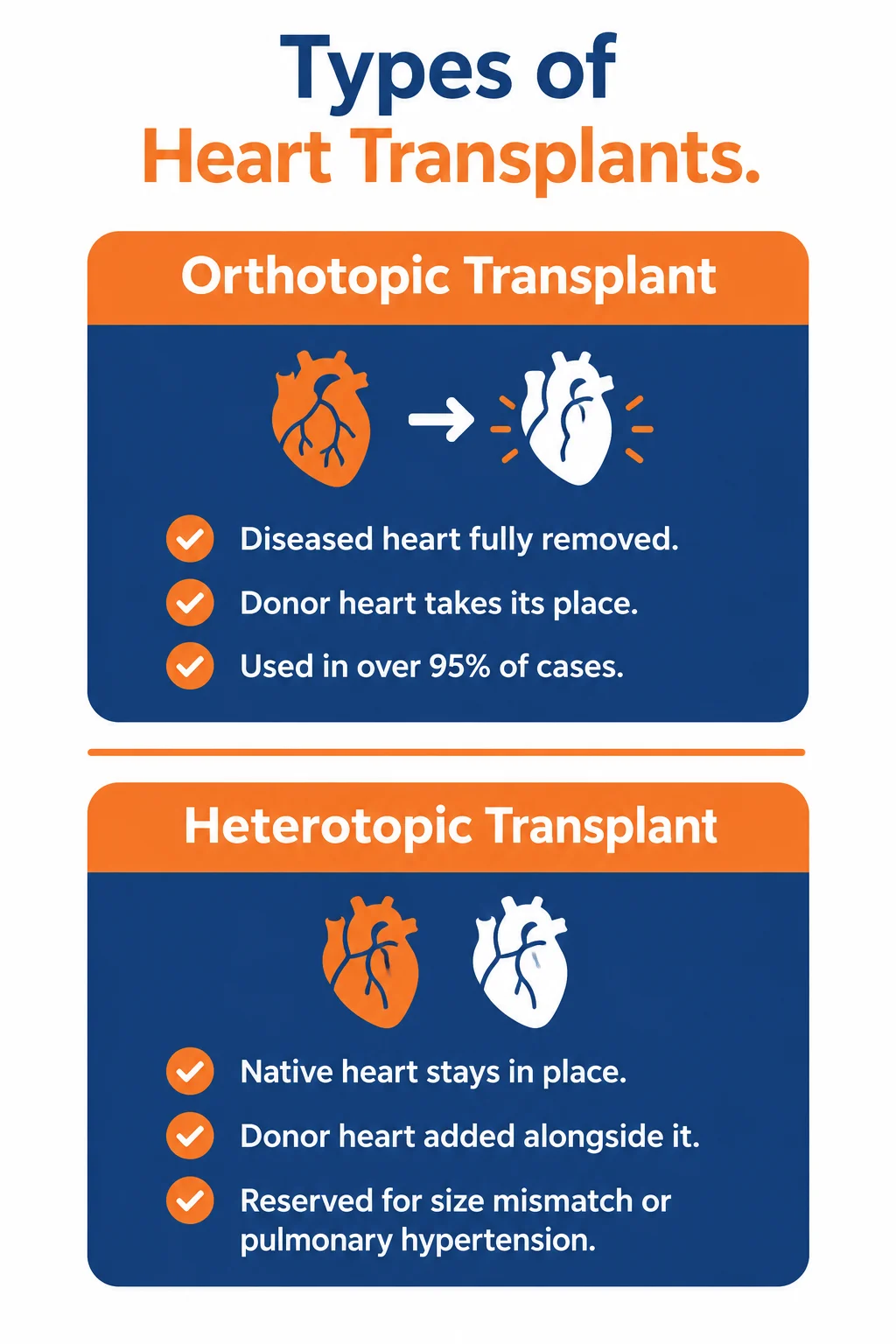
A third variant comes up occasionally in specialist discussions: domino heart transplant, where a heart-lung recipient’s own functioning heart gets passed on to a second patient. It’s uncommon and depends entirely on donor availability chains, but it’s worth knowing this procedure exists beyond the two standard categories.
Size matching between donor and recipient also plays into which approach gets chosen. When a donor heart would be too small to support the recipient on its own, heterotopic transplant lets the native heart stay in place and share the circulatory load.
Every type of heart transplant procedure carries its own risk profile and recovery pattern. More on heart transplant and what the full treatment path looks like at our center.
Wondering which type of heart transplant would apply to your case?
The decision isn’t left to preference. A handful of clinical factors point the team toward one approach or the other.
Overall risk profile: Orthotopic transplant is the standard approach and has a stronger long-term survival record, so it stays the default whenever the patient qualifies for it.
Pulmonary vascular resistance: High resistance in the lung’s blood vessels can overwhelm a donor heart placed alone. Heterotopic transplant lets the native heart share that load.
Donor size mismatch: A donor heart that’s too small for the recipient’s body may struggle on its own. Keeping the native heart in place adds backup capacity.
Transplant center experience: Heterotopic cases are rare, and not every center performs them regularly. That experience gap factors into where a patient gets referred.
Understanding these types matters most once a patient’s condition has already reached the point of requiring a transplant. Our guide on what pushes heart failure to need a transplant covers that earlier stage of the decision.
Dr. Vishal Khullar brings more than 30 years of experience in cardiac and transplant surgery, including training at Cleveland Clinic and a role as Senior Associate Consultant at Mayo Clinic in the US. He currently serves as Director of Cardiovascular and Thoracic Surgery, Heart and Lung Transplant at Fortis Hospital Mulund and Fortis S.L. Raheja Hospital, Mumbai, with experience across both orthotopic and complex re-operative transplant cases. Choosing between transplant types depends on pulmonary pressures, donor matching, and prior surgical history, an assessment carried out through a multidisciplinary transplant program.
Disclaimer: This blog is for general informational purposes only and is not a substitute for professional medical advice, diagnosis, or treatment; please consult a qualified doctor for any health concerns.