Post Views: 21



Mitral valve replacement involves taking out a valve that’s stopped working and putting a mechanical or biological substitute in its place. The mitral valve replacement procedure typically runs three to five hours under general anesthesia, with a bypass machine keeping circulation going throughout. Repair gets attempted first whenever the valve structure allows it, since replacement only becomes necessary once the damage is too extensive to fix. Every step, from opening the chest to weaning off bypass, follows a fixed clinical order.
According to Dr. Vishal Khullar, a leading Cardiothoracic Surgeon in Mumbai, “A mitral valve replacement procedure looks routine from the outside. It isn’t. Every stage, from gaining access and going on bypass to seating the valve and closing the chest, has to go right before the next one starts.”
Here’s the fixed sequence the mitral valve replacement procedure follows.
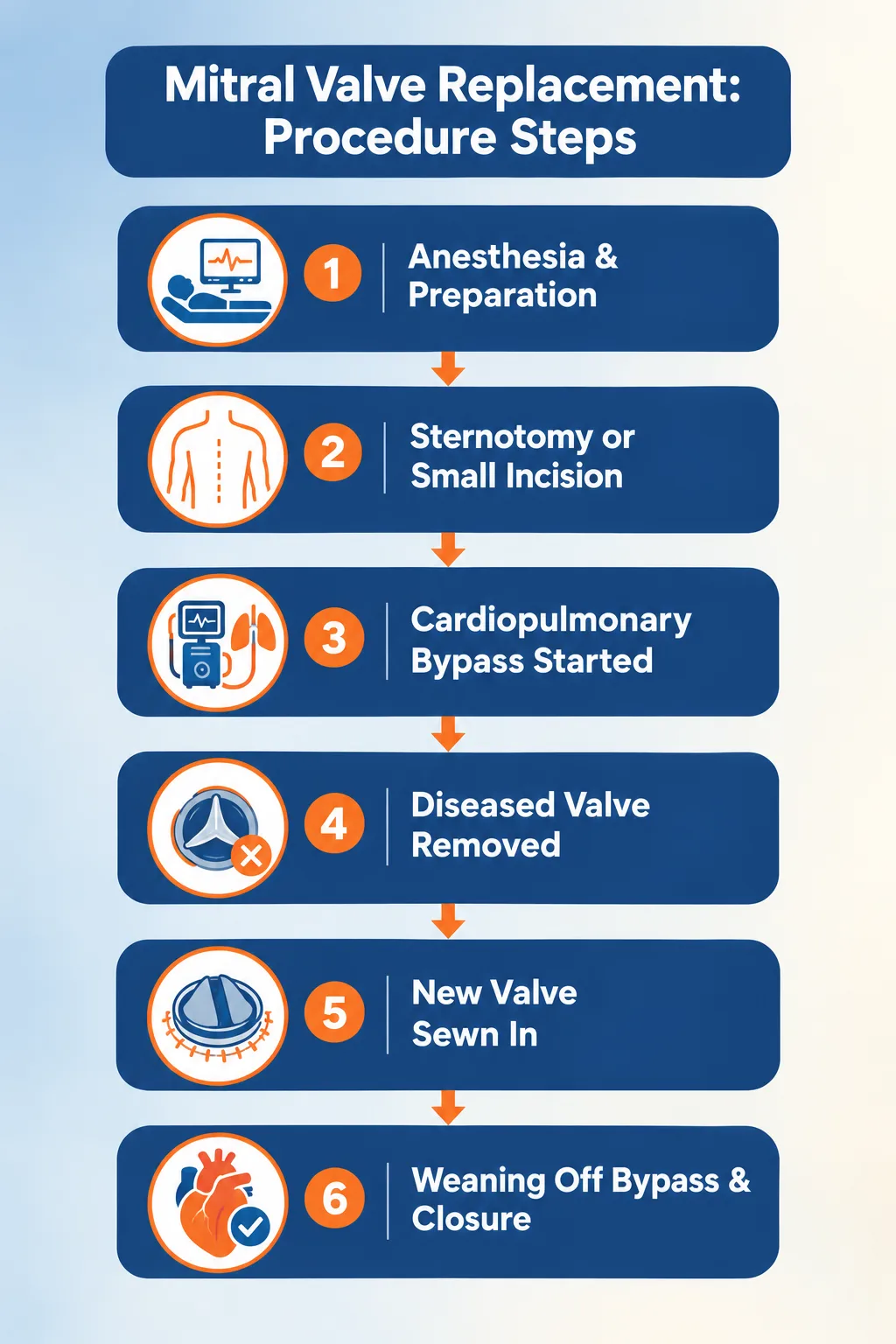
The valve choice gets made long before any of these steps start. Mechanical or biological, and it decides a lot about life after surgery. Mechanical valves hold up for decades. The tradeoff: blood thinners, for good. Biological valves skip that daily commitment but don’t last as long, so age and how active someone plans to stay both come into play. Once the new valve sits in place, the team doesn’t just assume it’s working. An echocardiogram runs right there on the table, before anyone closes up. That check matters. A valve that looks fine visually can still leak.
Recovery planning starts well before the operation itself. More on mitral valve surgery and what the full treatment path involves.
Curious whether your mitral valve can still be repaired instead of replaced?
Surgery is half the story. What happens in the days after decides the rest.
ICU monitoring: The first day or two happens in intensive care. Heart rhythm, blood pressure, how the new valve behaves, all watched without a break.
Breathing tube removal: Comes out within hours for most patients, as soon as breathing is steady on its own.
Medication management: Mechanical valve patients start blood thinners early. That’s a lifelong routine, not a short course. Biological valve recipients usually need far less long term medication.
Gradual mobility: Walking begins within a day or two. It builds up slowly, as chest tubes and lines are removed.
Recovery timelines vary by approach and by patient. Our guide on hospital stay after valve surgery breaks down what extends or shortens that window.
Dr. Vishal Khullar is a Cardiovascular and Thoracic Surgeon with over 30 years of experience in cardiac and valve surgery. His training includes time at Cleveland Clinic and a role as Senior Associate Consultant at Mayo Clinic in the US. His cases range from straightforward repairs to complex redo replacements, including Aorto-Mitral curtain reconstructions and third or fourth-time re-operations that many surgeons don’t take on. .
Disclaimer: This blog is for general informational purposes only and is not a substitute for professional medical advice, diagnosis, or treatment; please consult a qualified doctor for any health concerns.