Views: 367



Valve replacement alone may not be enough when infective endocarditis has spread beyond the valve into the annulus (the ring that anchors the valve) or the aortic root. An aortic root abscess can destroy the tissue that holds the valve in place, leaving behind cavities, fistulas, valve dehiscence, or injury to the heart’s conduction system. Treatment usually combines prolonged antibiotics with surgery to remove infected tissue, drain the abscess, repair or rebuild the damaged root, and replace the valve where needed. What the operation actually involves depends on where the infection sits, how far it has spread, any prior surgery, and the patient’s overall health, evaluated by an experienced cardiac surgeon in Cardiac Surgery.
According to Dr. Vishal Khullar: “In an aortic root abscess, simply replacing the valve does not eliminate the infection if damaged tissue remains. Successful surgery requires complete removal of infected tissue followed by stable reconstruction of the aortic root before valve replacement.”
Standard valve replacement doesn’t always address root involvement. If you want a second opinion before committing to a surgical plan, connect with Dr. Vishal Khullar.
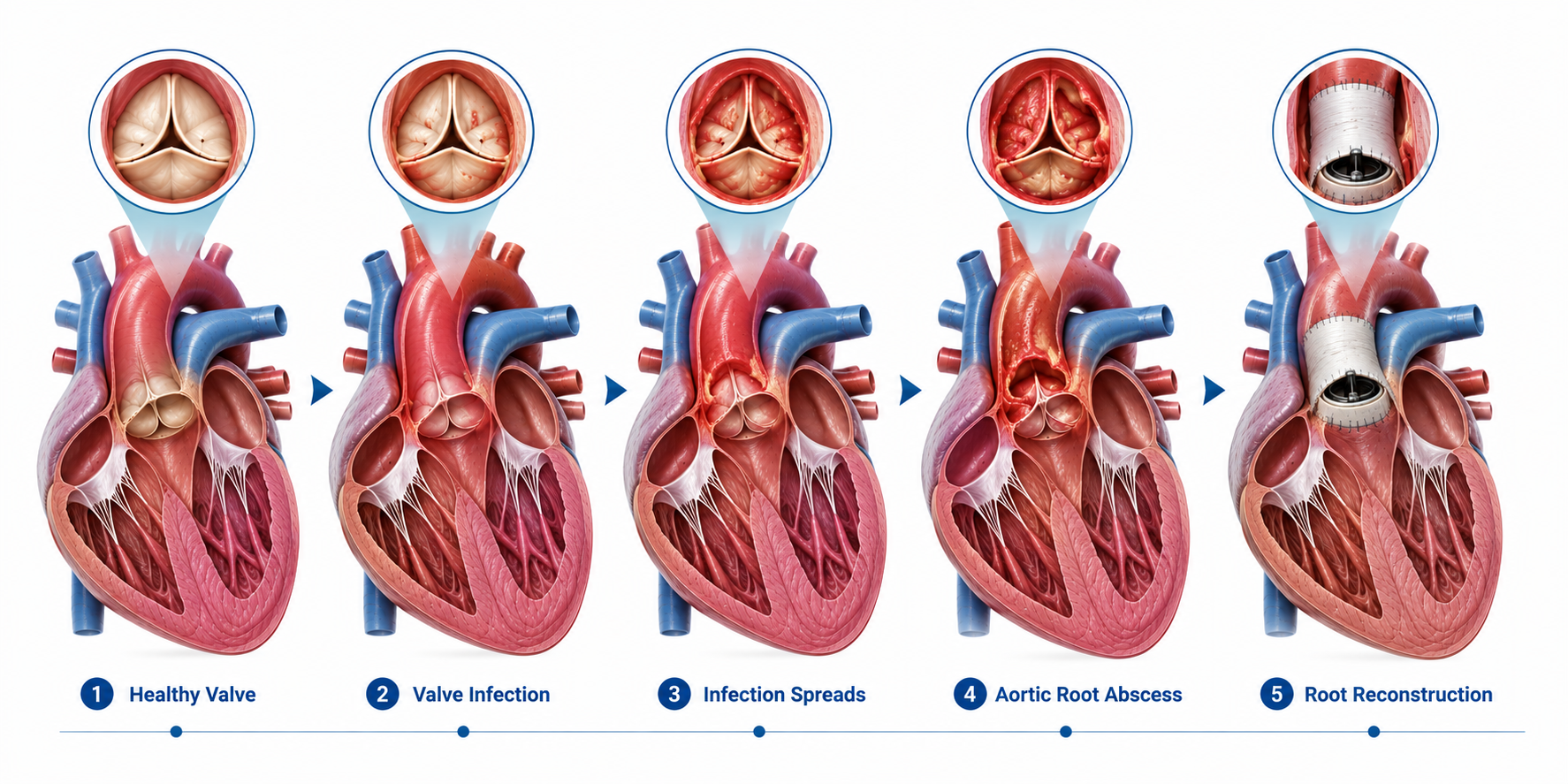
An aortic root abscess is a localized pocket of infected tissue, often containing pus, in the wall of the aortic root, the part of the aorta that surrounds and supports the valve. Doctors sometimes call it a peri-annular abscess. These terms describe infection in the tissue surrounding the valve, although doctors may use them somewhat differently depending on the exact location involved.
It develops as a complication of infective endocarditis, an infection of the heart’s inner lining. Bacteria, occasionally fungi, attach to the valve and spread into the tissue around it. Left untreated, that infection tends to progress rather than stay contained.
Most cases start on a valve leaflet, where bacteria clump together into what’s called a vegetation. From there, infection can extend into the annulus and further into the root, which is when an abscess, fistula, or dehiscence becomes possible. More detail on how this progresses is available in Surgery for Infective Endocarditis and Infective Endocarditis Symptoms.
Prosthetic valve endocarditis, infection involving a previously implanted valve, tends to destroy more tissue and is more often associated with root involvement than native valve infection.
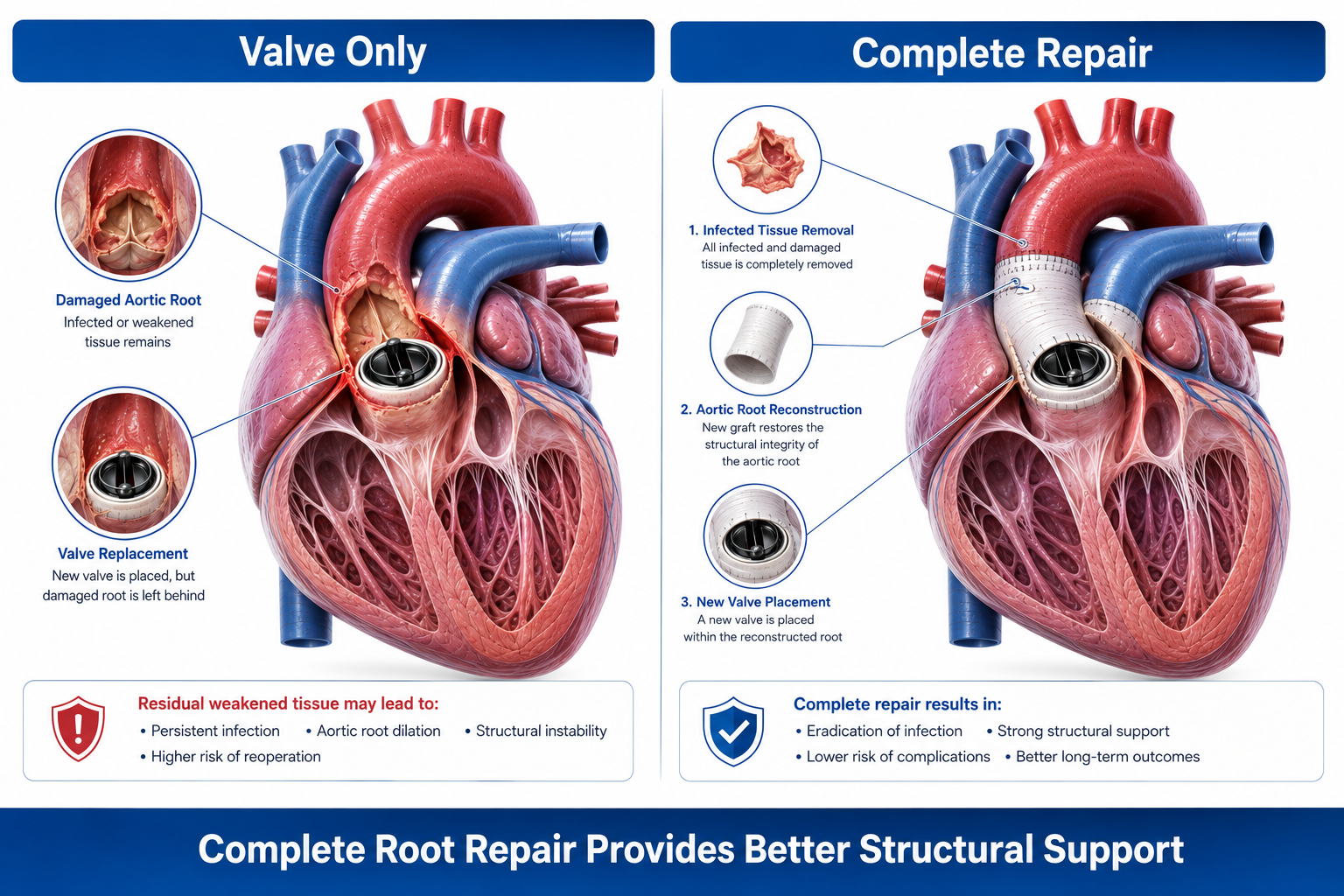
Infection doesn’t stop at the edge of the valve. Once it reaches the root wall, replacing the valve alone can leave infected or weakened tissue behind, which remains a continuing source of infection.
This isn’t a fixed rule for every patient. Valve replacement alone tends to fall short specifically when the abscess extends into the annulus or the root itself. At that point, the operation also needs to remove infected tissue and rebuild structural support around the valve. How much rebuilding is required depends on the extent of damage: sometimes a patch and localized debridement is enough, other times a full root replacement is necessary.
Antibiotics treat the infection, but they cannot rebuild tissue that has already been destroyed or clear an established abscess on their own. Most patients need both antibiotics and surgery, not one or the other. If infected tissue remains after surgery, the risk of persistent or recurrent infection, valve dehiscence, and repeat surgery increases.
The operation generally involves several steps, although the exact procedure varies from patient to patient:
This is a technically demanding operation, covered in more detail under Aortic Root Replacement and Aortic Valve Repair & Replacement Surgery. Patients with prior valve surgery face added complexity, discussed under Redo Cardiac Surgery.
|
Reconstruction |
Usually Considered When |
Main Consideration |
|
Root replacement |
Much of the root is damaged |
More complex, but rebuilds the affected area |
|
Homograft |
Destruction is irregular or extensive |
Donor availability and long-term durability vary |
|
Mechanical conduit |
Long-term durability is a priority |
Requires lifelong anticoagulation |
|
Bioprosthetic conduit |
Avoiding lifelong anticoagulation is important |
May degenerate over time |
The right option depends on how much of the root needs rebuilding, the patient’s age, kidney function, and their ability to manage anticoagulation long term.
A confirmed root abscess is an important finding that may support urgent surgery, particularly when other complications are present. Guidelines from the AHA and ESC point to several clinical findings associated with urgent or emergency surgery: heart failure from valve dysfunction, infection that doesn’t respond to antibiotics, a confirmed root abscess, a fistula, prosthetic valve involvement, valve dehiscence, and new heart block from infection reaching the conduction system.
Whether surgery becomes urgent or emergency depends on the patient’s stability and the extent of damage already present, a decision best made by a multidisciplinary endocarditis or cardiac surgery team.
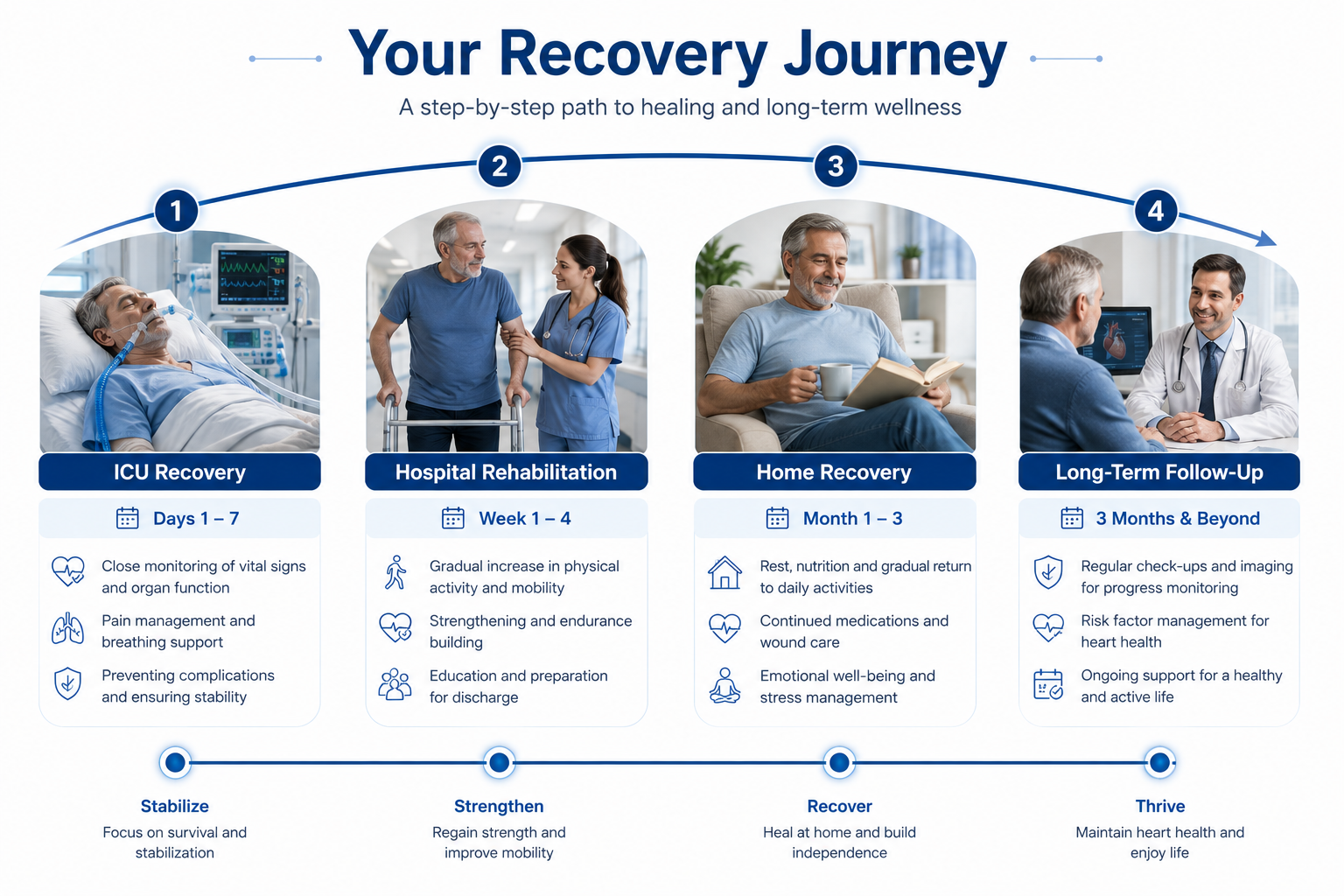
Recovery varies from patient to patient. ICU duration, ongoing antibiotic treatment, kidney function, and any complications or reoperation can all shift the timeline. The table below reflects a typical course rather than a fixed schedule.
|
Timeframe |
Typical Recovery May Include |
|
Week 1 |
ICU-based recovery, pain control, ventilator weaning, and monitoring for residual or recurrent infection |
|
Weeks 2 to 3 |
Wound healing, rehabilitation, and INR stabilization if a mechanical valve was used |
Antibiotics typically continue for 4 to 6 weeks in total, often extending past hospital discharge depending on culture results and the infectious-disease team’s plan. Patients with a mechanical valve or conduit need ongoing anticoagulation monitoring afterward, and some may need antibiotic prophylaxis before certain dental procedures; this should be confirmed individually with a cardiologist or dentist. More detail is available in Week-by-Week Recovery After Heart Surgery and After Heart Valve Surgery?.
A 2022 meta-analysis pooled six cohort studies and 1,982 patients with surgically managed infective endocarditis, comparing those with and without a root abscess. Patients with an abscess had higher in-hospital mortality (odds ratio 1.74) and higher late mortality (hazard ratio 1.27). Reoperation rates were similar between the two groups. In plain terms, a confirmed root abscess raises the stakes of surgery, which is why thorough, well-matched debridement and reconstruction matter.
A second study, co-authored by Dr. Vishal Khullar and published in The Annals of Thoracic Surgery (2021), followed 159 patients with complex active endocarditis at one institution. The table below summarizes the breakdown.
|
Category |
Patients |
|
Valve and patch reconstruction |
48 (30.2%) |
|
Full root replacement |
85 (53.4%) |
|
Mechanical valve |
50 (31.5%) |
|
Bioprosthesis |
56 (35.2%) |
|
Homograft |
53 (33.3%) |
Patients who received mechanical reconstructions were more likely to have native valve endocarditis, and less likely to need root replacement, than those who received bioprostheses or homografts. Risk-adjusted results showed outcomes tracking more with prosthesis type and procedure complexity than with valve choice alone. The main takeaway: the reconstruction a patient needs tends to follow how much root destruction is present, not simply which valve a surgeon prefers.
More peer-reviewed research is available on the Publications page, and further literature is searchable through PubMed.
Cost tracks with how much reconstruction is needed, not just whether an abscess is present.
|
Cost Factor |
What Influences It |
|
ICU care |
Longer stays for extensive destruction or slower recovery add cost |
|
Root replacement |
More resource-intensive than patch reconstruction alone |
|
Valve type |
Homograft, mechanical, and bioprosthetic conduits carry different material and logistics costs |
|
Surgical complexity |
Redo surgery or multi-structure involvement extends operating time |
|
Hospital stay |
Depends on infection control, wound healing, and any complications |
For a broader look at cost drivers, see Valve Replacement Surgery Cost in Mumbai.
Valve replacement alone is often not enough once infection reaches the aortic root, though the extent of surgery needed still depends on the extent of damage. Debridement matched to the disease, combined with root reconstruction where necessary, is central to lasting treatment. Because every patient’s anatomy and infection extent differ, this decision should be individualized and confirmed with a cardiac surgeon rather than following a fixed protocol.
More general questions about cardiac surgery are on the main FAQs page.
This article is for general education and does not replace urgent medical evaluation. For a clinical evaluation if imaging or symptoms suggest root involvement, contact Dr. Vishal Khullar.