Views: 868



Aortic coarctation repair widens a narrowed segment of the aorta so blood can reach the lower body without straining the heart. The condition shows up in roughly 5 to 8% of congenital heart defects, and it’s often missed until hypertension or a weak leg pulse sends someone for imaging. Left alone, the narrowing forces the heart to pump against higher resistance above the block while the lower body runs on less. Surgery or catheter-based stenting corrects that imbalance and gets circulation back on track.
According to Dr. Vishal Khullar, a leading specialist in Aortic Aneurysm Surgery in Mumbai, “Coarctation doesn’t always announce itself. In adults it’s sometimes just blood pressure that won’t respond to medication. Once imaging finds the narrowing, the real conversation is timing and technique.”
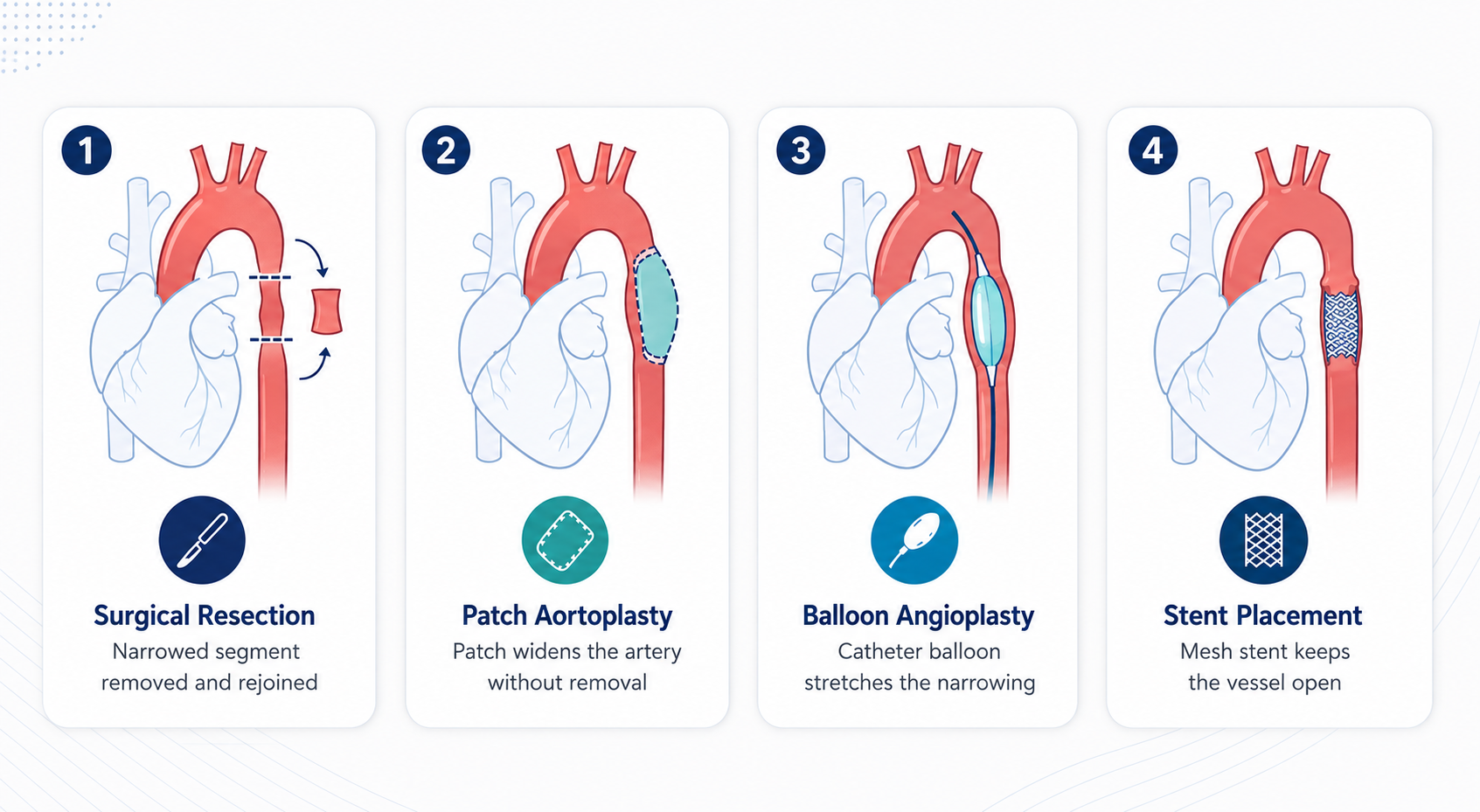
Resection: Removes the narrowed section and joins the healthy ends. Often used in infants and complex narrowing.
Patch aortoplasty: Uses a patch to widen the narrowed aorta, mainly for infants or long-segment narrowing.
Balloon angioplasty: Uses a balloon catheter to widen the narrowed area, mainly when the aorta is sufficiently grown.
Stenting: Places a stent to keep the aorta open. More common in older children, adolescents, and adults.
Age isn’t the only factor. The narrowing’s location, severity, and aortic anatomy also guide treatment. A tortuous arch or narrowing near major branches may make catheter-based treatment unsuitable, even in adults. And when the repair site sits at or near the arch itself, planning often overlaps with aortic arch replacement.
Blood pressure numbers that won’t budge on medication? A scan settles whether the aorta itself is the problem.
Recovery follows a fairly predictable path. But monitoring doesn’t stop once the patient goes home.
Hospital stay: Most patients spend five to seven days in hospital, in line with other open aortic repairs.
Blood pressure watch: Hypertension can persist even after a technically successful repair. Medication adjustment continues well past discharge.
Recoarctation risk: The repaired segment can narrow again over time. This shows up more in infants than in adults repaired later in life.
Long-term imaging: Regular CT or MRI scans track the repair site and check for aneurysm formation nearby, a known long-term risk.
For a sense of what a related aortic procedure involves, see our post on aortic root surgery.
Dr. Vishal Khullar brings more than 30 years of experience in cardiovascular and thoracic surgery to complex aortic cases. Trained at Cleveland Clinic and Mayo Clinic in the United States, he has handled aortic pathology across every segment, from the root to the arch. His approach leans on precise imaging before any decision on surgery versus stenting. He works with a multidisciplinary team on cases involving associated congenital defects. That combination of training and case volume matters most when the aorta itself is the problem.
Coarctation repair success hinges on accurate assessment of the narrowing and the surrounding anatomy before committing to an approach. Dr. Khullar’s experience across 7,000+ cardiac procedures includes complex aortic reconstructions where standard techniques don’t apply cleanly. Patients get a clear plan for the repair itself and for the blood pressure management that follows it.
Disclaimer: This blog is for general informational purposes only and is not a substitute for professional medical advice, diagnosis, or treatment; please consult a qualified doctor for any health concerns.