Views: 491



Donor heart wait time in India ranges from a few days to two or three years. On average, patients in high-volume Mumbai centres wait six to 18 months. India performs around 250 heart transplants a year. The estimated need, however, is 50,000. As a result, nearly 25 to 30 percent of listed patients die before a matching heart arrives.
Dr. Vishal Khullar is an experienced Cardiac Surgeon in Mumbai, India. He trained at Mayo Clinic and Cleveland Clinic. Today, he leads the heart and lung transplant program at Fortis Mulund. Moreover, he has been part of more than 300 heart and lung transplants. This guide explains how the wait works, what shapes it, and how to survive it in 2026.
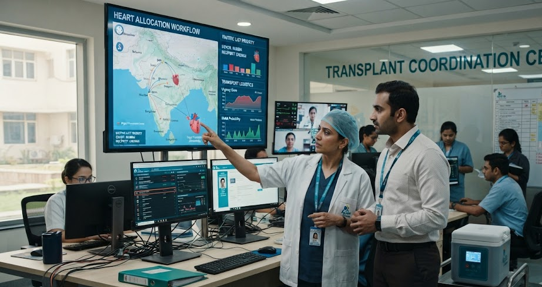
India runs a tiered allocation system. Most families have never heard of it. Yet, understanding it changes everything about the wait.
When a donor heart becomes available, the city gets first priority. Next, the zone. Finally, the rest of the country. Therefore, listing in the right city matters a lot. Mumbai centres receive far more donor hearts than smaller cities.
After the team clears you for heart transplant, you receive an urgency status. Status 1 patients sit on inotropes, mechanical support, or ECMO therapy. They get top priority. Status 2 patients live at home on medicines and wait longer.
The wait is not random. A few clear factors decide whether the call comes in two months or two years.
Blood group is the biggest factor. You cannot change it. The wait varies sharply across groups.
| Blood Group | Average Wait | Best Case | Worst Case |
| AB | 3 – 9 months | Few days | 12 months |
| A | 6 – 15 months | Few weeks | 18 – 24 months |
| B | 6 – 18 months | Few weeks | 24 months |
| O | 12 – 24 months | 3 – 4 months | 36+ months |
Group O patients wait the longest. However, AB patients usually wait the least. Group AB can accept hearts from any donor.
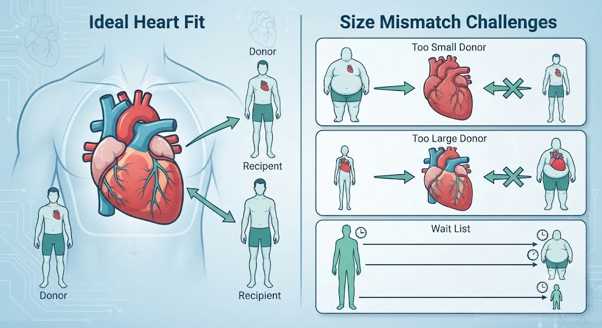
The donor heart must fit the chest. A 90-kg patient cannot accept a 45-kg donor’s heart. Very tall, very heavy, and very small patients all wait longer.
Status 1A patients on ECMO sit at the very top. Status 1B patients on inotropes or LVAD come next. Stable Status 2 patients at home wait the longest.
Therefore, list early. Do not wait for a crisis to push you up the list. By then, organ damage may already be too far gone. For a deeper read on who qualifies, see this guide on heart transplant waiting list eligibility.
Mumbai, Chennai, Hyderabad and Delhi do most of India’s heart transplants. Mumbai alone, through ZTCC, has one of the country’s largest donor pools. Listing in a smaller city can quietly add a year to your wait.
India needs around 50,000 heart transplants a year. We perform about 250. Furthermore, one in four listed patients dies before a heart arrives. NGOs often soften this number. Families deserve to hear it directly so they can plan.
The wait is rarely passive. The medical team optimises drugs, watches the kidneys and liver, and decides when to escalate. There are three layers of support.
Diuretics, beta-blockers, ARNIs, SGLT2 inhibitors and IV inotropes are used carefully. For many patients, drugs alone bridge the entire wait. For others, they do not.
When medicines stop working, an LVAD – Left Ventricular Assist Device becomes the next step. The LVAD is a mechanical pump. It takes over the work the heart can no longer do. Patients on LVAD often walk, eat well and go home. As a result, they enter transplant in much better shape.
ECMO is the most aggressive bridge. Doctors use it when patients cannot survive without immediate support. Furthermore, it buys days to weeks while a heart or LVAD is arranged.
Heart transplant in India costs roughly INR 15 to 35 lakhs. International packages start at USD 40,000 and can reach USD 70,000. In contrast, the same surgery in the US or UK costs three to five times more.
Foreign patients can list at private centres. However, Indian citizens always keep priority on the national list. The process is legal, regulated, and handled centre by centre.
High-volume centres with strong donor networks shorten the wait. Low-volume centres lengthen it. Moreover, the team’s experience with LVAD and ECMO directly affects whether patients survive the wait.
Dr. Vishal Khullar’s training at Mayo Clinic and Cleveland Clinic brings exactly the kind of decision-making that keeps patients alive long enough to be transplanted.
The wait for a donor heart in India is long and stressful. Blood group, body size, urgency status and city of listing all shape it. Yet, one in four listed patients does not survive long enough. The patients who do well list early, choose a high-volume centre and accept bridge therapy when needed.