
This website is being reviewed and updated in line with the National Medical Commission (NMC) guidelines on ethical advertising and public communication by registered medical practitioners.

What Is Cardiopulmonary Bypass and How Does It Work?

During open heart surgery the heart often has to be stopped, and the body still needs blood and oxygen. Cardiopulmonary bypass (CPB) covers that gap. A heart lung machine takes over the work of the heart and lungs, oxygenating and pumping blood back to the body so the surgeon can operate on a still, relatively bloodless heart. Most cardiopulmonary surgery that needs a stopped heart depends on it. Here’s how it works.

According to Dr. Vishal Khullar, a Cardiothoracic Surgeon in Mumbai, “The bypass machine doesn’t fix the heart. It buys the surgeon time on a still, quiet heart.”

How Does a Cardiopulmonary Bypass Machine Work?

Here’s how blood moves through the bypass circuit.
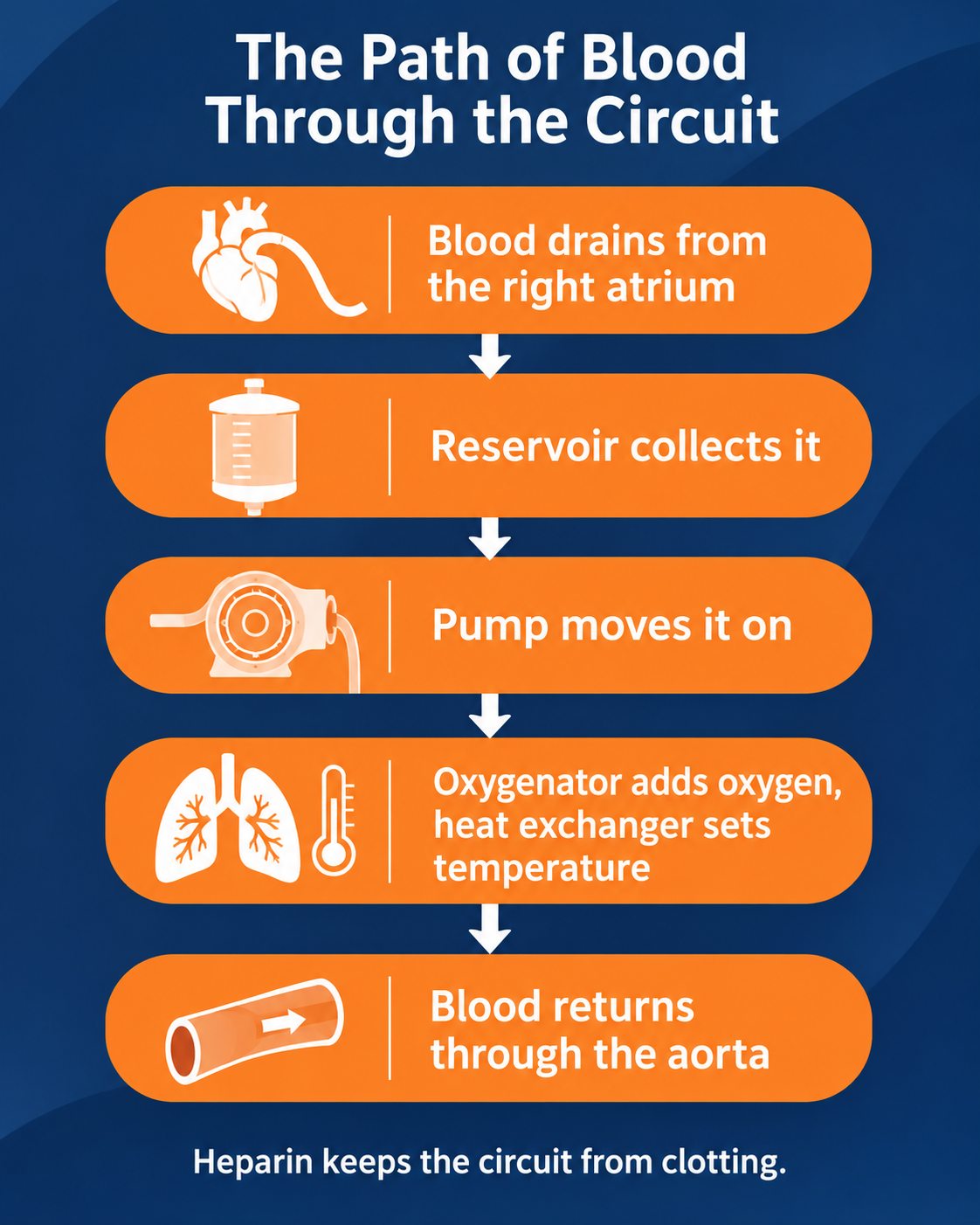
Five step flow showing the blood path in the bypass circuit: drained from the right atrium, collected in a reservoir, moved by a pump, oxygenated and temperature controlled, then returned through the aorta.
  • Draining the blood: Everything starts at the right atrium or the large veins, where the surgeon places a hollow tube called a venous cannula. Blood drains out through it, with gravity doing most of the pulling, and collects in a reservoir.
  • Adding oxygen: A pump carries the blood from the reservoir to the oxygenator. Inside are very thin hollow fibres. Blood passes around the outside of them and gas passes through the inside, which is how oxygen gets in and carbon dioxide gets out.
  • Setting the temperature: The oxygenator has a heat exchanger attached. The team can cool the blood, which lowers the body’s oxygen needs, and warm it back up near the end.
  • Returning the blood: Before it returns, the blood goes through a filter that catches small particles. An arterial cannula, usually in the ascending aorta, then delivers it back to the body. At the same time the heart is stopped with cardioplegia, a potassium based solution, so the field stays still.

Planned grafting of blocked arteries is explained on our heart bypass surgery page.

Need guidance about heart surgery or your treatment options?

What Is the Difference Between CABG and CPB?

They sound alike and often turn up together, but they do different jobs.

Feature

CABG

CPB

What it is

A surgery that reroutes blood around blocked heart arteries

A technique that takes over heart and lung work

Main purpose

Restore blood flow to the heart muscle

Keep the body supplied during the operation

Heart during surgery

Stopped or beating, depending on the method

Usually stopped

Other uses

None, it’s a single operation

Valve repair, aortic surgery, transplants and more


Different jobs: Grafting is the repair. The machine is the support that keeps the rest of the body supplied while that repair is made.

On pump and off pump: Most grafting is done “on pump”, with the machine running. Off pump surgery works on a beating heart using stabilizing devices and skips the machine.

What trials show: A review of 86 trials and 10,716 participants found no benefit from skipping the machine for stroke or heart attack. Mortality was slightly higher without the machine, at 3.7 percent against 3.1 percent, and fewer grafts were placed per patient.

Beyond bypass surgery: The machine also supports valve repair, aortic aneurysm repair and heart transplants, wherever the heart has to be stopped.

Valve operations that use the machine are covered in our guide to valve surgery recovery.

What Are the Risks of Using a Heart Lung Machine?

There are side effects to being on the machine, even for a few hours, and the team plans for each one.
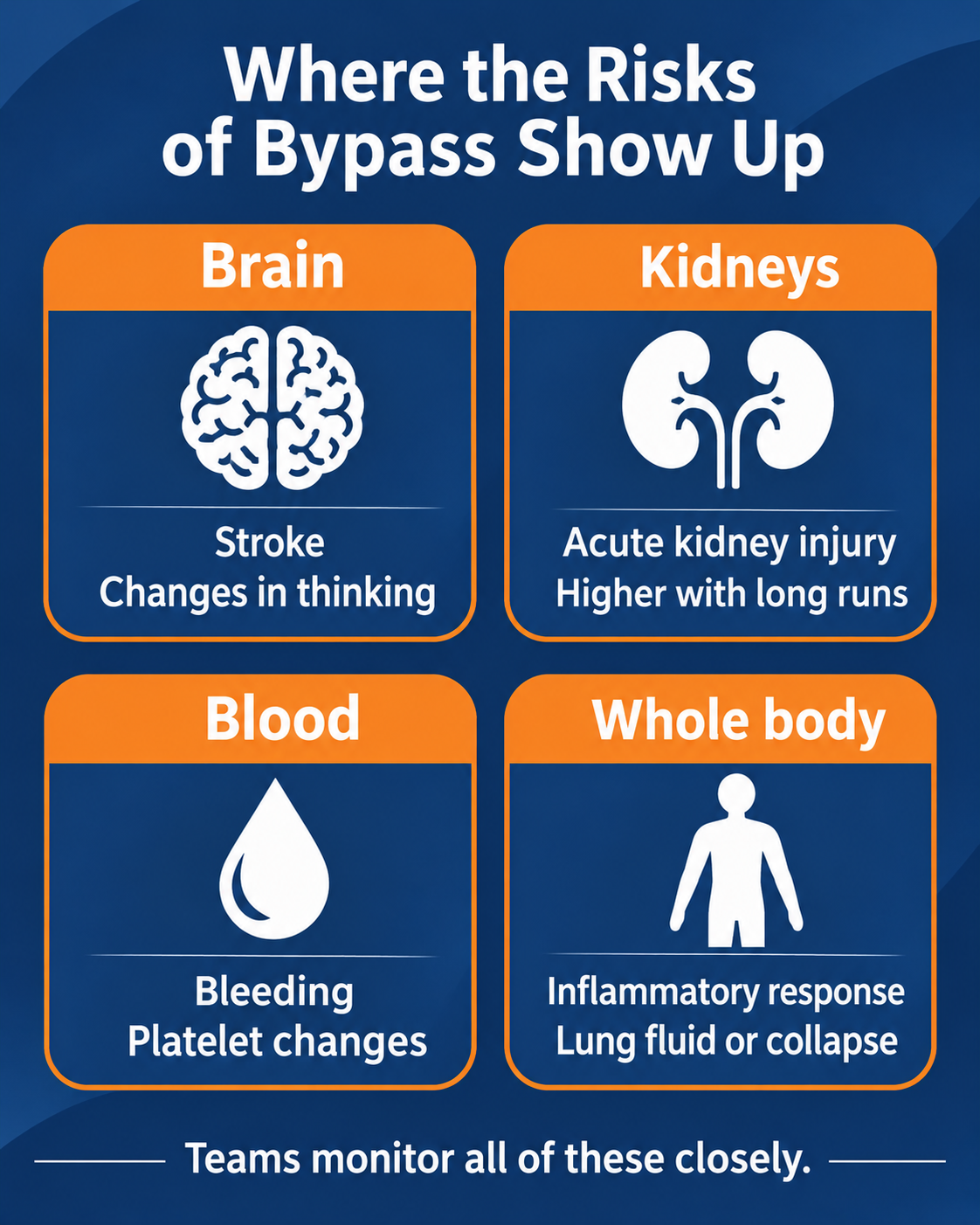
Four category cards showing risks of cardiopulmonary bypass to the brain, kidneys, blood and whole body.
  • The brain: Clots, air bubbles or poor blood flow can reach the brain and cause a stroke. Some patients also notice changes in thinking afterwards.
  • The kidneys: The kidneys can be injured too, and the risk rises with a longer time on the machine, an infection or diabetes.
  • Bleeding: Patients are given heparin so the blood doesn’t clot in the circuit. The machine also affects platelets, so bleeding is watched closely.
  • Inflammation: Blood meeting the circuit’s surfaces can trigger a body wide inflammatory response. Some patients also get fluid around the lungs or a partly collapsed lung.

For longer support away from the operating room, ECMO therapy works on a similar idea.

Key Takeaways

Cardiopulmonary bypass means a machine does the work of the heart and lungs during open heart surgery. Blood is drained, oxygenated, warmed or cooled, and sent back to the body. Grafting is the repair and CPB is the support. Stroke, bleeding and organ injury are the main risks. Whether it’s needed for a given operation is the cardiac surgeon’s call.

FAQs

What is cardiopulmonary bypass surgery?

An operation where a machine does the heart’s pumping and the lungs’ oxygen work.

How does a cardiopulmonary bypass machine work?

It diverts the blood from the body, adds oxygen, sets the temperature and pushes it back.

What is the difference between CABG and CPB surgery?

CABG uses grafts to bypass blocked coronary arteries. CPB is the machine that supports blood circulation and oxygen supply during surgery.

Do all heart operations need cardiopulmonary bypass?

No. Off pump grafting is done on a beating heart without the machine.

Refrences

Disclaimer: This blog is for educational and informational purposes only and should not be considered professional advice.

Book Online Consultation Book An Appointment
Powered by Joinchat
Call Now Button