Post Views: 28



A donor heart stays viable for four to six hours outside the body, and this narrow
window is the single biggest factor shaping heart transplant outcomes. Once that time is exceeded, the risk of primary graft dysfunction (PGD) climbs sharply. Every minute spent on procurement, cooling, transport, and implantation counts.
Dr. Vishal Khullar has spent more than 30 years in cardiac surgery and has handled transplant cases where timing genuinely decided the outcome.
According to Dr. Vishal Khullar: “Ischemic time isn’t just a clock running in the background of a transplant. It shapes almost every decision, from which donor heart to accept to how the retrieval and transport are planned. A well-coordinated team can make a three-hour transport feel routine. A poorly coordinated one can turn ninety minutes into a crisis.”
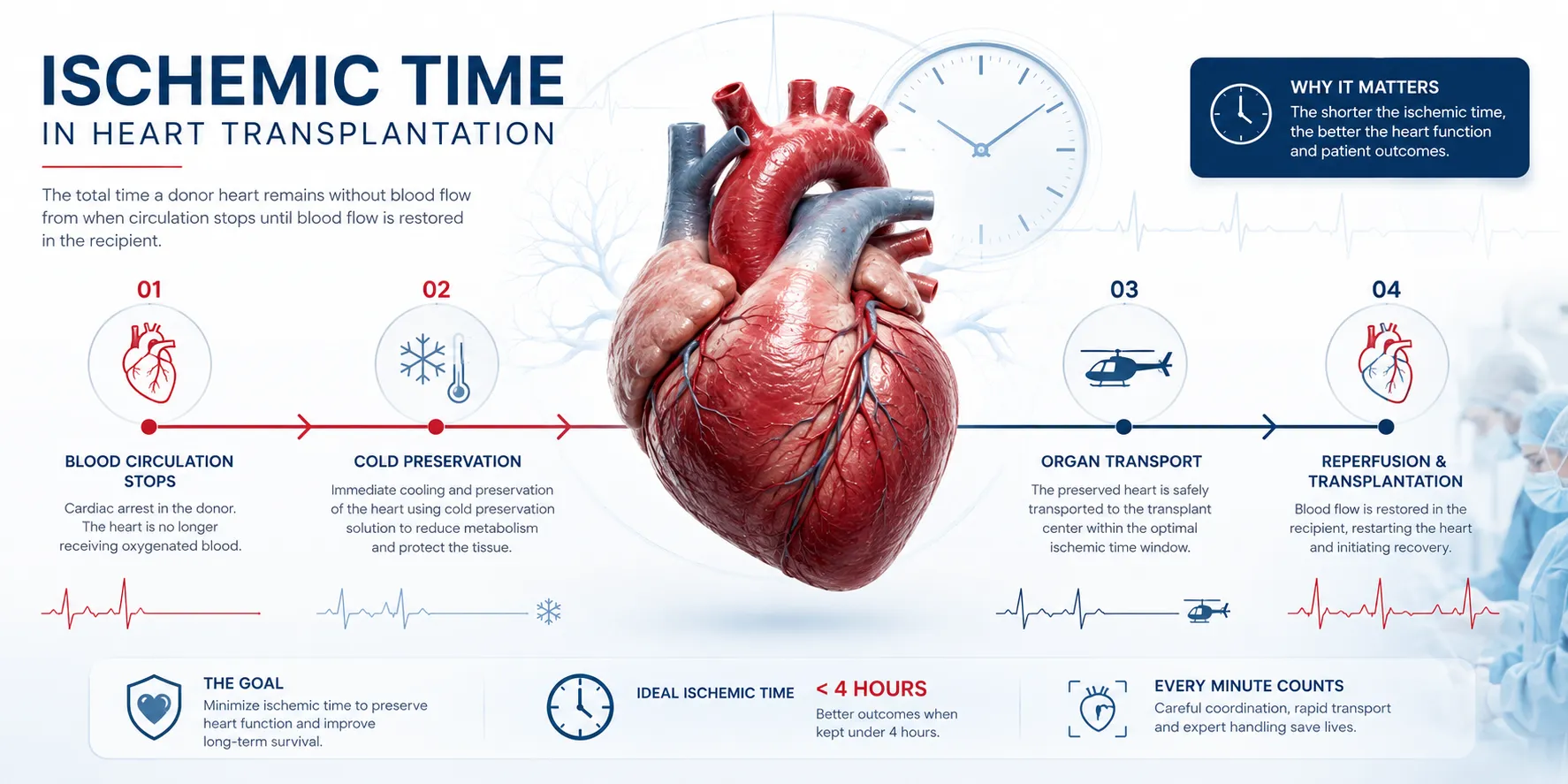
Ischemic time is simply the period a donor organ spends without a normal blood supply. Doctors break it into two types.
Cold ischemic time begins the moment surgeons cross-clamp the donor aorta and flush the heart with cold preservation solution. It runs through transport and ends when the heart is reperfused in the recipient.
Warm ischemic time is any stretch the heart goes without cooled perfusion. During a standard retrieval, this is usually brief. It matters a lot more in donation-after-circulatory-death (DCD) cases, where the heart sits in warm ischemia before doctors can even start cooling it.
Compare that to a kidney, which can often handle 24 or more hours of cold storage. The heart doesn’t get that luxury. Its constant pumping and high metabolic demand mean damage can start setting in within just a few hours, so transport teams treat every minute like it matters, because it does.
For years, the rule has been simple: keep cold ischemic time under four hours. Large registry data still backs this up, though the full picture turns out to be more layered than that.
One analysis of the International Society for Heart and Lung Transplantation (ISHLT) registry looked at over 80,000 transplants. Ischemic times of four hours or more, versus under two hours, carried a hazard ratio of 1.2 for donors aged 40 to 59. For donors 60 and older, that risk jumped to a hazard ratio of 2.0.
So ischemic time isn’t acting in isolation here. Donor age changes how much it matters. An older donor heart simply doesn’t tolerate a long transport the way a younger one does.
More recent UNOS-based studies push that safe threshold even earlier. One found that survival risk starts climbing once ischemic time passes three hours, with the sharpest impact showing up in the first 90 days post-transplant. Four hours is still the number most people cite. But three hours is really where things start to shift.
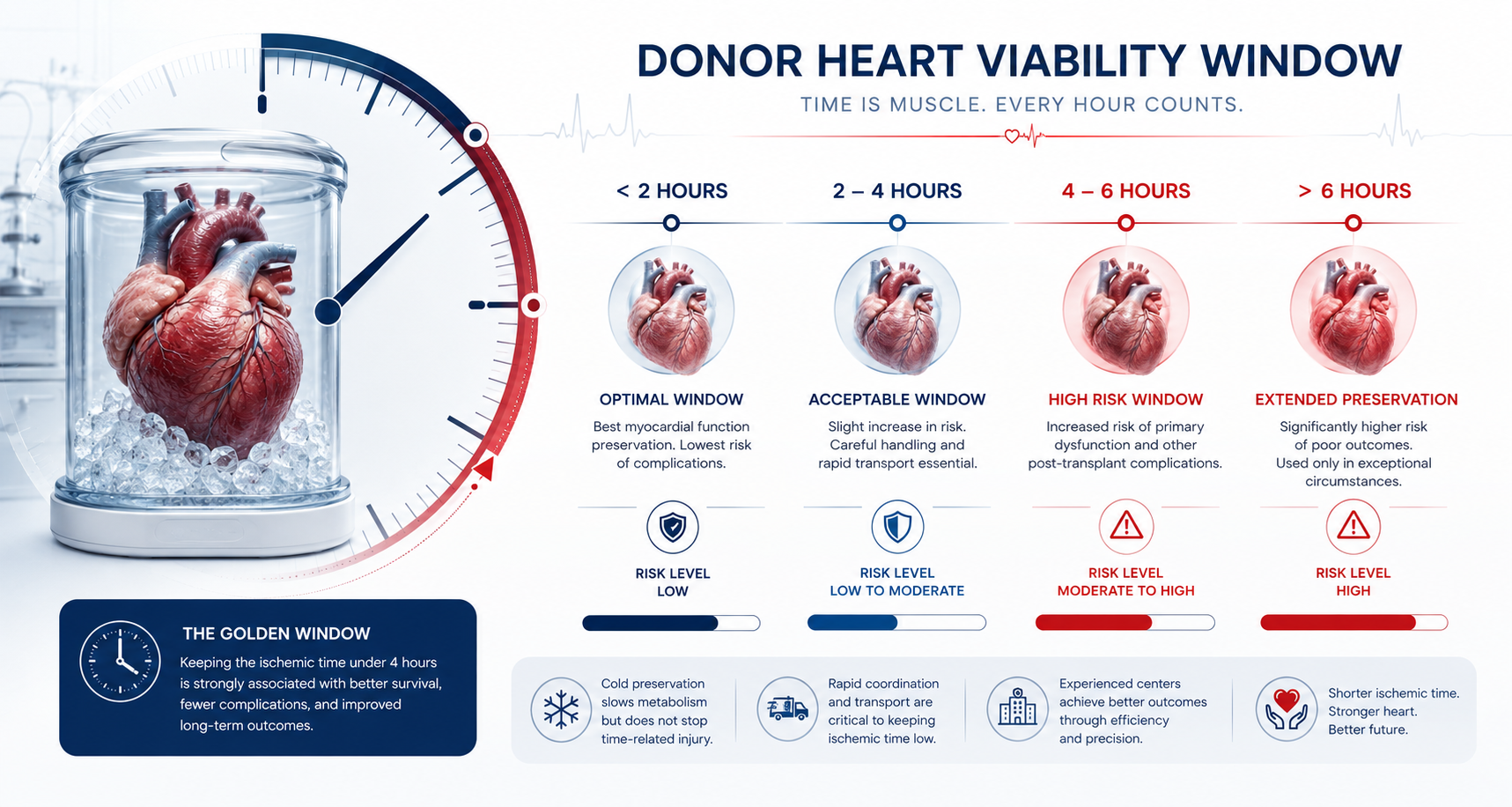
On standard cold storage, four to six hours is the norm. Machine perfusion technology has pushed that further, often to eight or nine hours, and in a handful of documented cases, surgeons have completed successful transplants past the 12-hour mark.
Go beyond the standard range and risk climbs. Still, perfusion-based preservation is rewriting what “the outer limit” even means, especially for hearts coming from far away or from donors who become available unexpectedly late.
Considering a Heart Transplant Evaluation?
Timing, donor matching, and surgical precision all affect outcomes. Talk to a specialist before you decide on next steps.
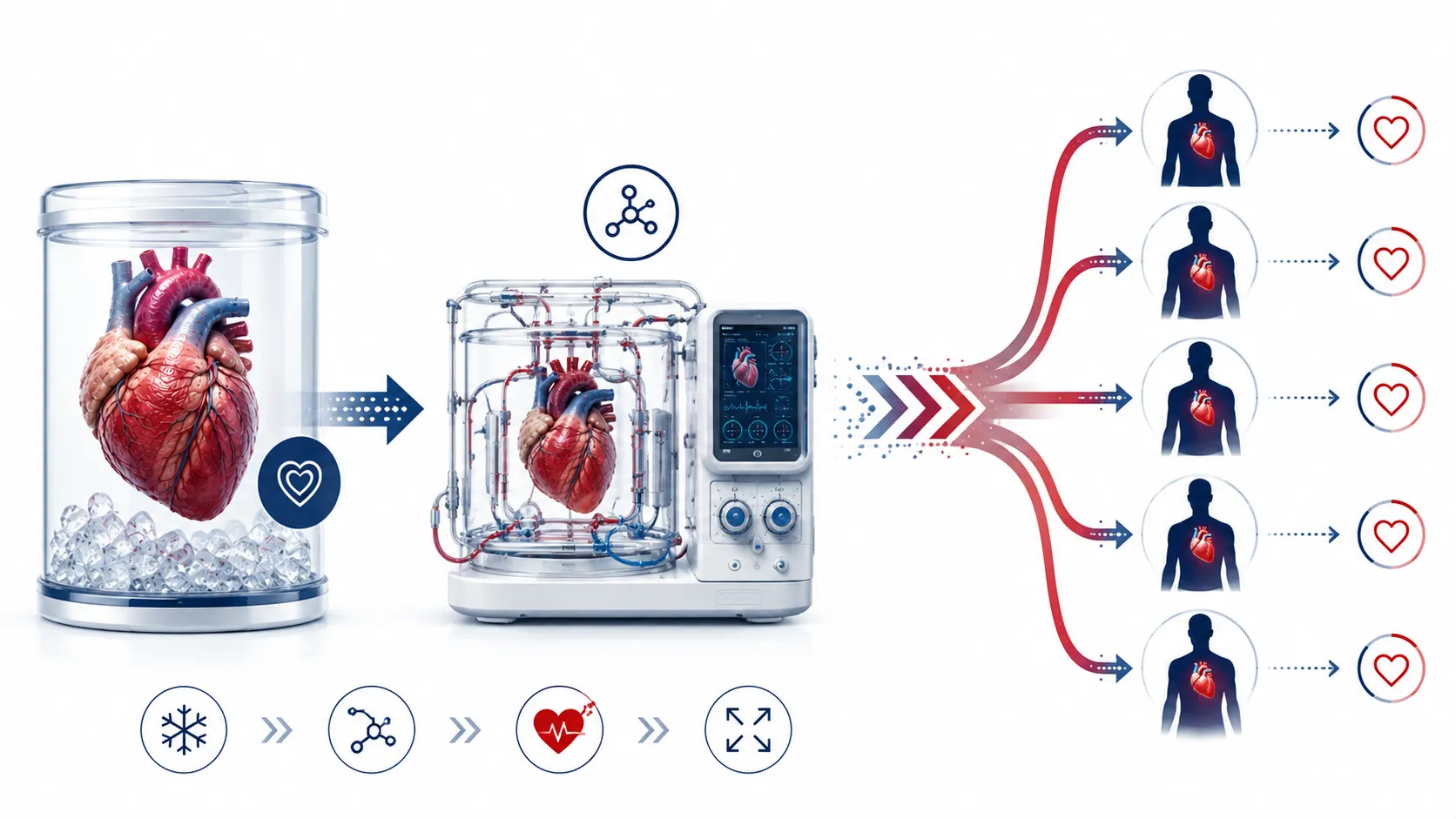
Getting a donor heart from procurement to implantation isn’t a loose process. It follows a tight sequence, and each step has to happen fast:
Hospital handoff and implantation. The heart goes straight to the operating theatre. Since the patient’s already prepped, there’s barely any gap between arrival and reperfusion.
Yes, and it doesn’t just kick in past some fixed cutoff, the risk builds gradually the whole way.
Registry data shows one-month mortality climbing from around 9% in the shortest cold-ischemia quartile to 19% in the longest. One-year mortality follows a similar path, rising from 16% to 28%.
Beyond roughly four hours, cold ischemic time independently raises the risk of primary graft dysfunction, along with both short and long-term mortality.
| Cold Ischemic Time | Associated Outcome Risk |
|---|---|
| Under 2 hours | Lowest baseline risk; reference point in most registry studies |
| 2–4 hours | Modestly elevated risk; still within standard practice range |
| 4–6 hours | Meaningfully higher risk of PGD, 1-month and 1-year mortality; risk further amplified in older donor hearts |
| Beyond 6 hours | Historically considered high-risk with standard cold storage; increasingly reserved for perfusion-preserved organs |
There’s also a stroke risk tied to longer transport times, a reminder that the fallout from a slow transport isn’t limited to how the graft itself performs.
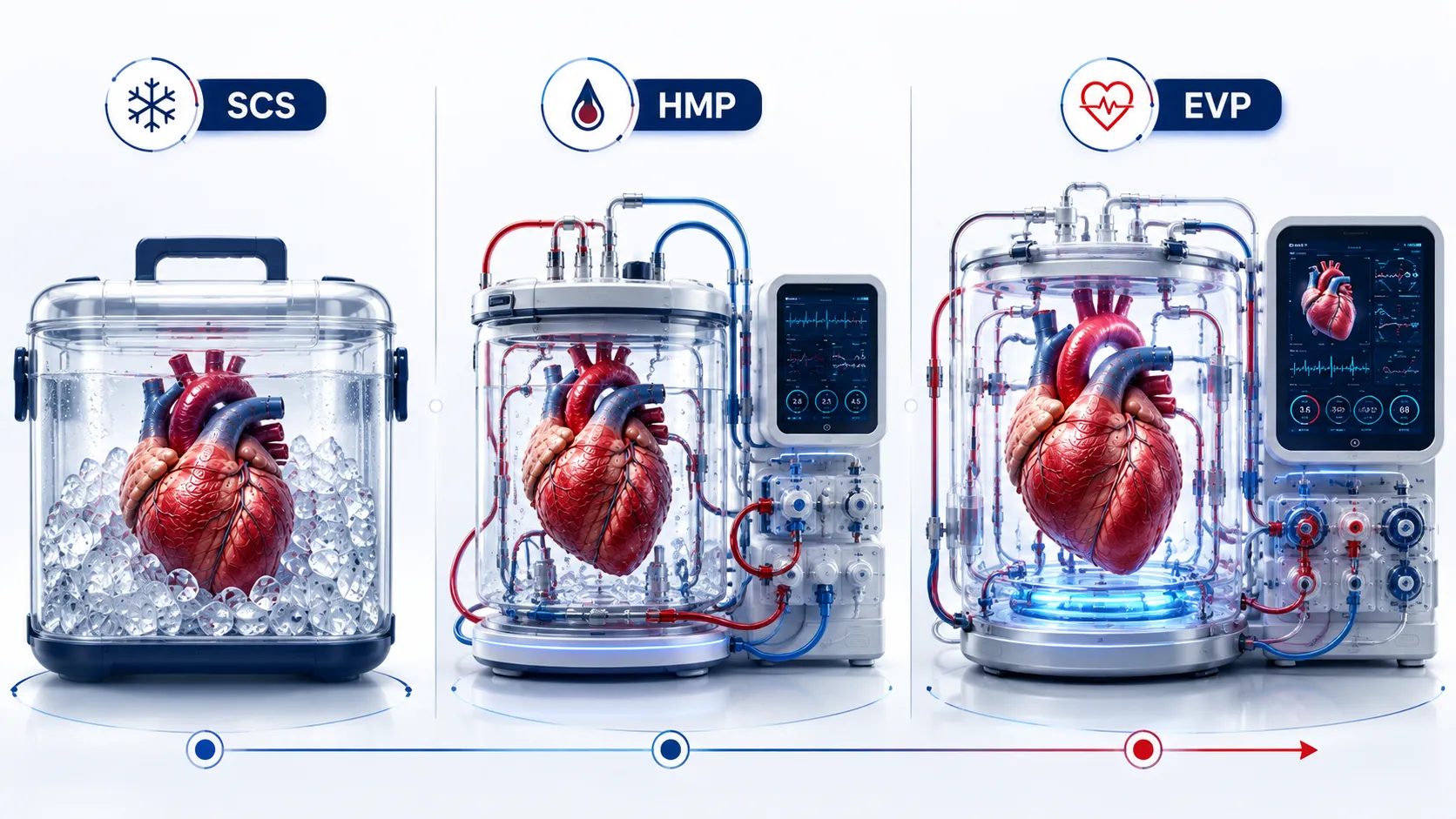
Three main preservation methods dominate transplant practice right now, and each comes with its own tradeoffs.
|
Method |
How It Works |
Typical Extended Ischemic Window |
|
Static Cold Storage (SCS) |
Heart is flushed with cold solution and packed on ice, no active perfusion involved |
Standard 4–6 hour range |
|
Hypothermic Machine Perfusion (HMP) |
Cold, oxygenated solution keeps flowing through the heart during transport instead of just sitting in ice |
Extends viability meaningfully beyond standard cold storage in early clinical use |
|
Ex-Vivo/Normothermic Perfusion (e.g., TransMedics OCS Heart) |
The heart is reanimated, warmed, and perfused with oxygenated donor blood, so it’s essentially still working during transport |
Total preservation times of roughly 8–9 hours are common, with select cases going past 12 under specialized protocols |
Worth watching: controlled hypothermic storage around 10°C, a step up from the usual near-freezing temperatures. Early data hint that this gentler cooling might cut down on cold-storage injury while still keeping metabolic demand low, a sort of middle ground between plain ice and full machine perfusion.
These preservation advances aren’t just about convenience, they’re changing which hearts can be used at all.
Take donation after circulatory death (DCD) hearts. They go through a period of warm ischemia before procurement even starts, which is exactly why they were written off as unusable for so long.
That’s shifting now. Normothermic perfusion platforms let surgeons reanimate and actually test how these hearts function outside the body. So more transplant programs are turning to DCD and other marginal donor hearts that used to fall outside the criteria, and that’s opening up real options for patients stuck on the waiting list.
For a firsthand look at how a complex, high-risk transplant unfolds from evaluation to recovery, see this transplant case study.
Weighing Your Transplant Options?
Every case is different. Get a clear, personalized assessment of your candidacy and risk profile.
Every heart transplant runs on a tight, unforgiving clock, typically four to six hours, with risk building noticeably in those final hours.
What’s actually changing is the ceiling itself. Machine perfusion and better donor-age-adjusted risk models are giving surgical teams more breathing room, and they’re helping bring previously unusable DCD and marginal donor hearts into play for patients still waiting.
At Dr. Vishal Khullar’s practice, patients get access to advanced transplant evaluation and coordinated surgical care. Learn more about our heart transplant program, or read a related post on redo sternotomy risk for patients with prior cardiac surgery.
Disclaimer: This blog is for general informational purposes only and is not a substitute for professional medical advice, diagnosis, or treatment; please consult a qualified doctor for any health concerns.